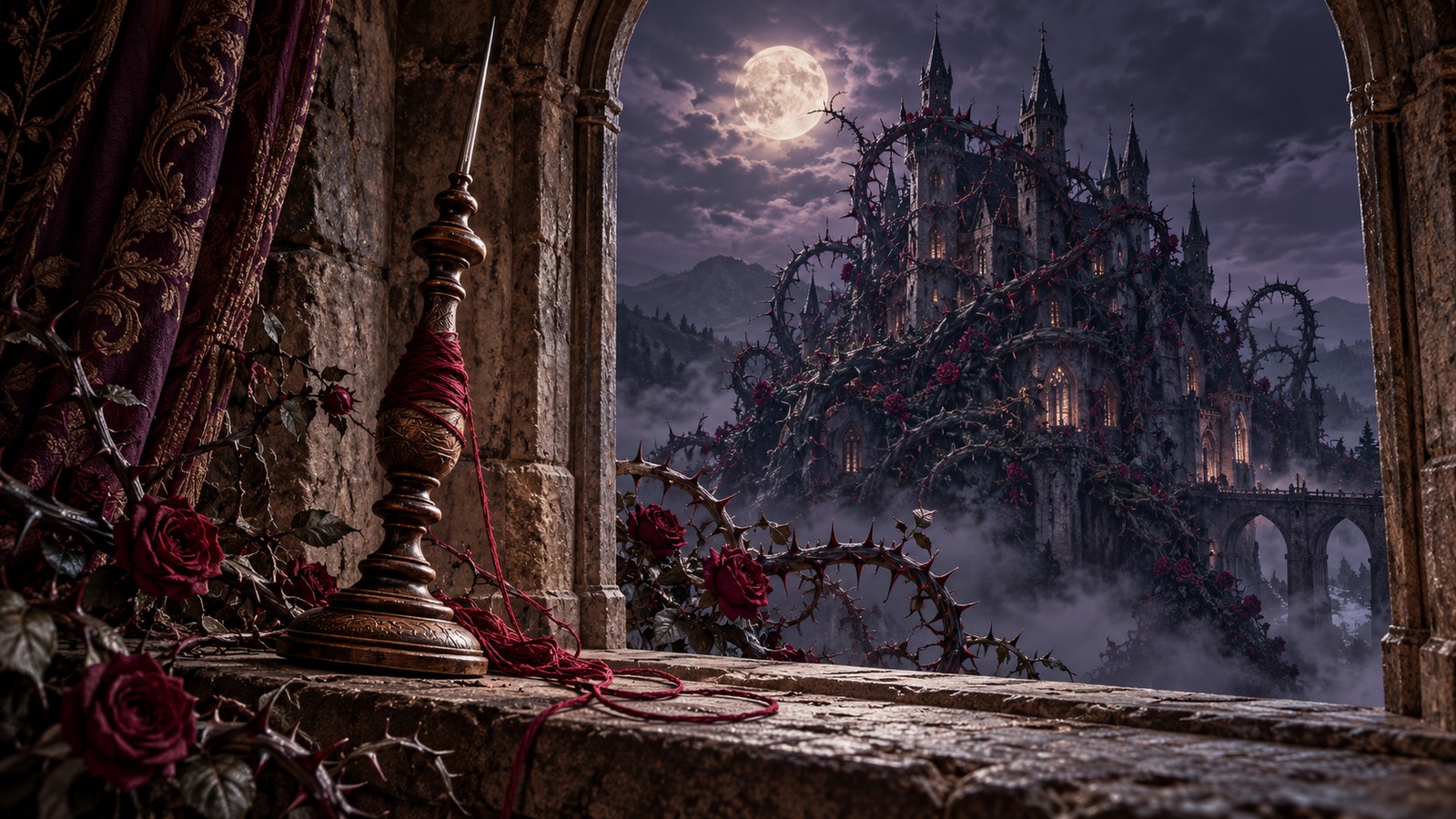
The princess wakes up, marries the prince and has two children. Then his mother decides to eat them.
Readers searching for the Sleeping Beauty original story often expect a single suppressed ending: the terrible bit that a later adaptation cut. The surviving texts offer something stranger. There are several related stories, and their threats do not fall in the same place.
Giambattista Basile’s Talia, Charles Perrault’s sleeping princess and the Grimms’ Briar-Rose share a recognisable shape. A young woman, a warning, a sharp object, an unnatural sleep. After that, the differences matter. Combining the worst incidents from all three creates a powerful horror summary, but it also creates a story none of those authors wrote.
Basile: a splinter of flax, not a romantic awakening
An earlier literary version appears in Basile’s Pentamerone, published posthumously in the seventeenth century. Its title is Sun, Moon, and Talia. The version discussed here is Richard F. Burton’s unexpurgated English translation. Abridged English editions sometimes remove the assault and even change the king’s wife into his stepmother, so the choice of text matters.
Talia’s danger comes from flax. A splinter lodges under her nail, and she falls into a deathlike state. A king discovers her while she is unconscious, sexually assaults her and leaves. She later gives birth to twins, Sun and Moon. One of the babies draws the splinter from her finger while seeking milk, and she wakes.
Those events need plain language. Calling the king’s act a kiss, a seduction or an enchanted romance removes Talia’s inability to consent. Nothing in that part of the story requires an adult reader to mistake the king’s conduct for tenderness.
Nor does waking end the danger. The king already has a wife, who orders the children cooked and served to their father. A cook protects them by substituting animals. Talia is then threatened as well. The conflict ends with the queen’s destruction and the king’s marriage to Talia, a resolution that can feel deeply uneasy after what the text has already told us about him.
Perrault: the ogress comes after the wedding
Perrault’s The Sleeping Beauty in the Wood, included in his 1697 collection, gives the story a different arrangement. The princess falls asleep after pricking her hand on a spindle. The court sleeps with her; a thick growth closes around the castle; a prince arrives when the hundred years have elapsed.
In A. E. Johnson’s English translation, the prince kneels beside her and she wakes as the appointed time ends. A kiss is not the stated mechanism of awakening in this passage. That familiar detail belongs to other tellings.
The prince marries her, and they have two children. Then Perrault keeps going.
The prince’s mother is an ogress. Once she has power over the young queen and the children, she orders them prepared for dinner. A steward hides the intended victims and serves animals in their place. When the deception is discovered, the ogress prepares a vat of dangerous creatures for the family and the people who saved them. The king returns, and his mother throws herself into the vat.
This is a different cannibalism plot from Basile’s. Here the threat comes from a mother-in-law with an explicitly monstrous appetite, rather than the king’s existing wife. Describing both women merely as “the evil queen” loses the relationships that make each version disturbing.
Grimm: the hedge has already killed other princes
The Grimms’ Briar-Rose is closer to the version many readers recall from childhood: a royal celebration, a fairy excluded from it, a death curse softened into a hundred-year sleep, and a spindle in a tower.
Its dark detail is waiting outside the castle. Princes who arrive too early become caught in the thorn hedge and die there. When the right day comes, the flowers part for the successful visitor. He has arrived at the permitted time, while the others have encountered a boundary that kills.
In Margaret Hunt’s translation of the Grimm story, the prince kisses Briar-Rose and she wakes. The court resumes its interrupted movements. A wedding follows, and the tale ends. There is no later ogress episode in this text.
The castle’s suspended household is wonderfully precise. A cook is still poised to strike a kitchen boy; a maid is about to pluck a bird; flies remain on a wall. When the spell breaks, ordinary activity starts again from the exact point at which it stopped. Even a century has failed to interrupt the household’s habits.
There is no single hidden dark ending
These versions make Sleeping Beauty’s dark ending a question of edition:
- Basile places sexual violence and the birth of twins inside the period of sleep, then adds a murderous wife.
- Perrault lets the princess wake and become a mother before an ogress threatens her and her children.
- Grimm ends with awakening and marriage, after establishing the fatal cost paid by earlier visitors to the hedge.
The distinctions make the stories more unsettling, not less. Talia wakes to discover what has happened to her body. Perrault’s princess survives the famous curse only to face danger within her new family. Briar-Rose’s ending depends on a clock that has already condemned other people.
Those are three different uses of the same frightening possibility: a person can be present while losing control over what happens around them.
Hearing a classic fairy tale in full
An unabridged reading lets the order of events do its work. A plot summary may put the wedding last because that is where a reader expects safety. Perrault’s text refuses that comfortable stopping point.
EXORCISTA: Dark Fairytales is devoted to complete English readings of classic fairy tales by Victoria Unikel. Check the official episode catalogue for released readings and the planned calendar; a story discussed in the journal should not be mistaken for an episode already available to play.
To begin listening now, The Red Shoes is released. For another apparently safe house that turns predatory, read Hansel and Gretel’s original story.
Sources and edition note
- Giambattista Basile, Sun, Moon, and Talia, translated by Richard F. Burton.
- Charles Perrault, Old-Time Stories, translated by A. E. Johnson.
- Brothers Grimm, Household Tales, translated by Margaret Hunt: Briar-Rose.
- The 1697 French text of Perrault’s tale, reproduced on Wikisource.
The discussion distinguishes these texts rather than treating their incidents as one composite original. The accompanying illustration is an editorial interpretation.