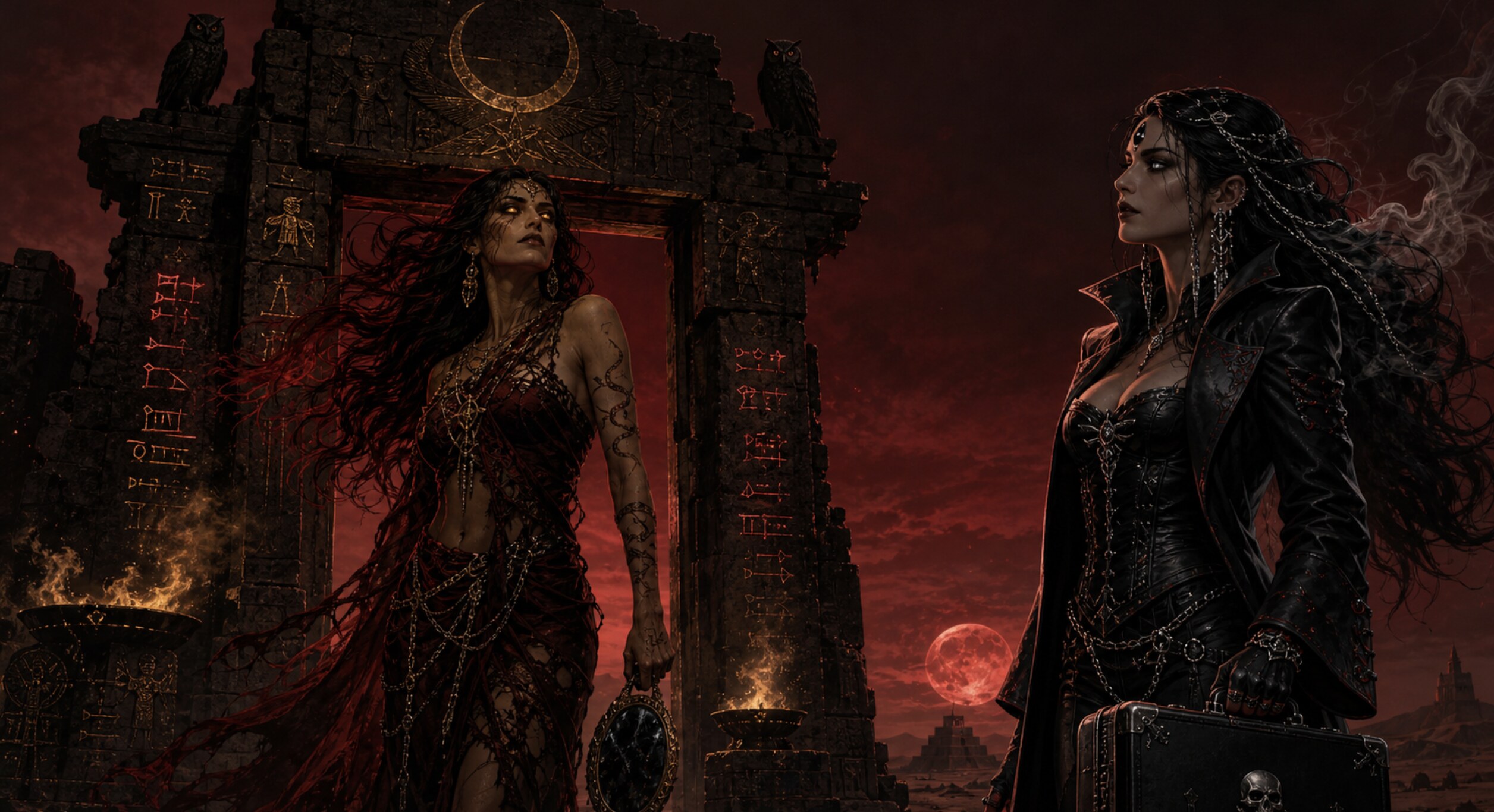
Lilith is trending again, the way she does every few years when a story needs a female demon who is older, angrier, and more interesting than the men around her. In 2026 she's turning up across anime — as a devil in Black Clover, a succubus in The Strongest Magician in the Demon Lord's Army Was a Human, a primordial figure in One Piece's lore. And she anchors the newest episode of EXORCISTA: Games of Souls. So it's worth knowing who she actually is under the fan art.
The oldest version: night, and the stealing of children
Lilith predates the Bible. In Mesopotamian tradition she belongs to a class of lilitu — night-spirits associated with wind, storm, and the deaths of infants and mothers in childbirth. That's the root that never washes off. Long before any garden or apple, Lilith is the thing the ancient world blamed when a child did not survive the night. She is a demon of the dark hours and of mothers, which is a far stranger and more specific job than "evil woman."
The Garden of Eden version: the refusal
The story most people half-remember comes later, from medieval Jewish folklore — most famously a satirical text called The Alphabet of Ben Sira. In it, Lilith is Adam's first wife, made from the same clay as him rather than from his rib. She refuses to lie beneath him, argues that equal creation means equal standing, and when she loses the argument she simply leaves — speaks the ineffable name of God and exiles herself to the air near the Red Sea. She would rather be a demon on her own terms than a wife on someone else's.
That's why she endures. Every era that has a fight about women's autonomy rediscovers Lilith, because she is the myth that framed refusal as damnation. In the Kabbalistic Zohar, she and Naamah are folded into the machinery of the cosmos as seducers and mothers of plagues. The scholarship is dense; the image is simple. A woman who would not be subordinate became the oldest name for the dark.
Why she's the perfect demon for a family vlogger
EXORCISTA's third episode takes a momfluencer named Diana Wells — 18 million subscribers, a channel built entirely on her three children — into Content Hell. The demon it hands her is Lilith, and the choice is exact.
Mythic Lilith devours children and haunts mothers. Corrupted-motherhood is her literal domain. But the show adds one modern twist that turns her into the sharpest demon in the season so far: this Lilith feeds on being watched. She needs the lens the way the mythic one needed the night. Her weakness is a dark room. Turn the cameras off and she starves — she dies performing to no one, reaching for an audience that isn't there.
It's a clean piece of mythmaking. The ancient demon of stolen children meets the modern crime of children sold to an audience, and the flaw that kills her is the same flaw that killed the channel: she could not survive not being seen. For how the show handles this without ever exploiting the kids on screen, see our EP3 breakdown.
Lilith in the wider Universe
Every Games of Souls demon is a real one wearing a modern crime. Mammon, the demon of greed, hosts the influencer's Russian Roulette. Azazel, the scapegoat demon, runs the crypto scammer's chess match. Lilith, the night-mother, runs the family vlogger's Hide & Seek. The full demon roster lines up sin against sin.
Then Exorcista walks in and ends the game — the silver-eyed collector who is one thousand souls short of her contract, and who is very good at making demons meet the truth they were built to hide.
Lilith has survived four thousand years of being written down by people who feared her. A dark anime is just the latest room she's refused to sit down in.