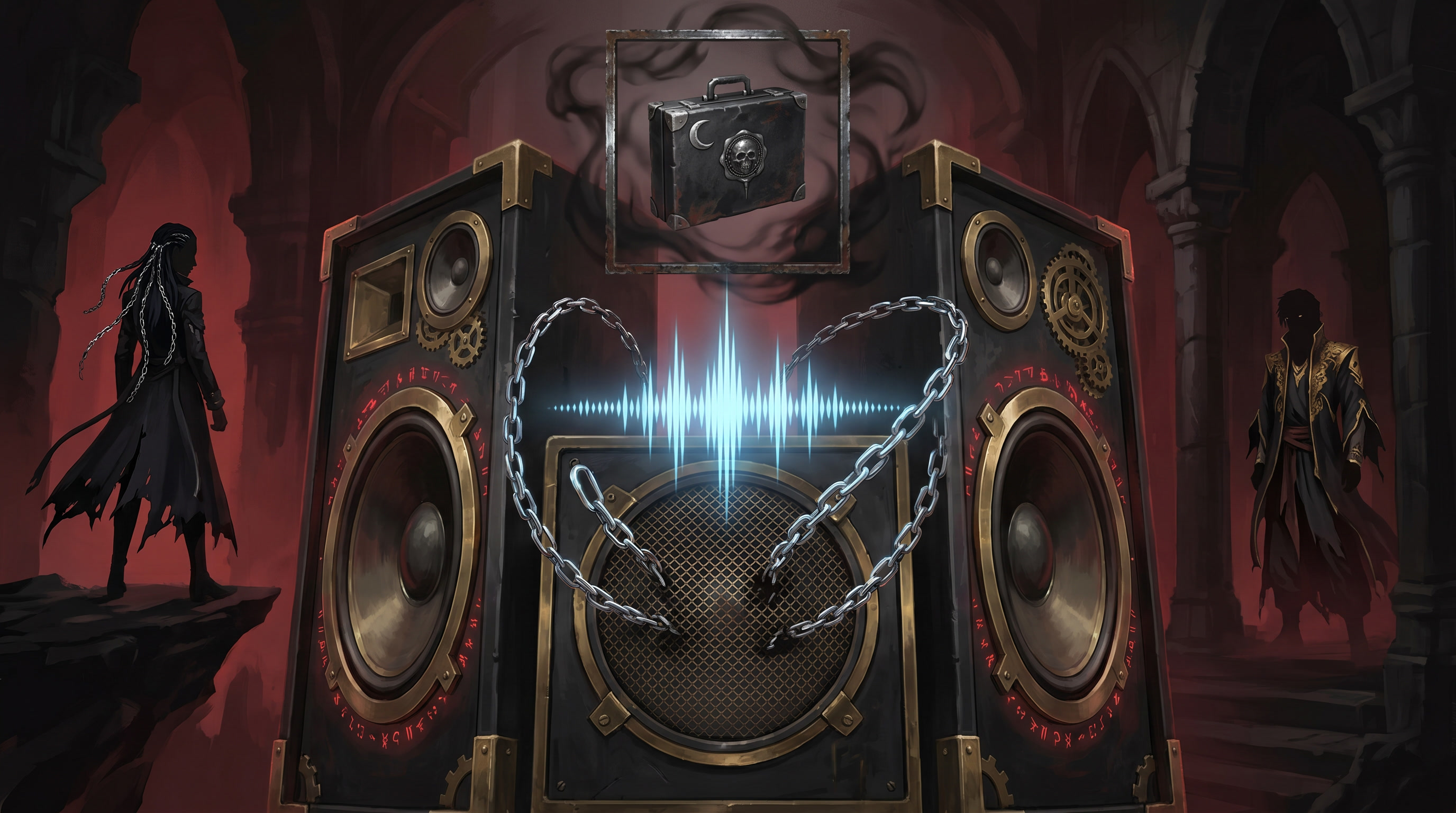
The soundtrack to EXORCISTA: Games of Souls doesn't sound like anime. It sounds like industrial metal, drift phonk, and symphonic horror produced for a dark anime audience that was raised on Mick Gordon's DOOM and Trent Reznor's score work — not on shōnen orchestral cues. The album is called Russian Roulette. It's by Exorcista on Unikel Records. Thirteen tracks. Every track is a scene. Album II — Checkmate — drops May 15 ahead of EP2.
This is the listening guide. Track-by-track, in the order they map to the episode.
Why a dark anime needed an industrial metal score (and not "epic trailer music")
The default audio language for animated horror is symphonic — strings, brass swells, choirs going into rounds of "ahhh-ahhh-AHH." It's the epic-trailer-music sound that has dominated anime promo cuts for fifteen years. It works for trailers. It does not work as the score that the audience comes back to listen to on its own, on Spotify, in their car, before bed.
The audience for EXORCISTA: Games of Souls is the audience that already listens to KORDHELL, Trent Reznor, Mick Gordon, Rammstein, Sara Landry, Nitepunk, and Sleep Token. The listening profile skews 18-25, gamer-adjacent, anime-adjacent, horror-friendly, terminally online. The score had to function as standalone listening for that audience or it would have failed twice — failed as a score and failed as an album.
Industrial metal solved the standalone problem. Drift phonk solved the YouTube-Shorts cadence problem (it cuts into 8-second hooks cleanly). Symphonic horror solved the moments where the show actually does need a string swell — the Exorcista entry, the soul collection beat, the soul counter increment.
The album is structured as one episode of one show. Listen to it in order and you've heard EP1.
Track 1 "Exorcista" — the leitmotif of the collector
The opening track is the leitmotif of the title character. It plays under Exorcista's entry every time she enters Content Hell — the 2-second silence, the chain drag, the theme starting on the third beat. Industrial metal core (Rammstein-adjacent), 90 BPM, D minor. Drop-tuned guitars. Choral layer in the second half of the track ("EX-OR-SIS-TA" in war-chant cadence) that the audience already started chanting back at the show in the first week.
If you've watched EP1 you've heard the cleaner instrumental version of this track. The full vocal version is on the album.
Track 2 "Ding Ding" — the bell that opens every game
A short interlude track. The detuned-music-box version of the Squid Game–era childlike-creepy bell. Plays under the START THE GAME moment in every episode. Two bells, low BPM, three repeats, then silence. Functions as the album's "reset" between heavier tracks.
This is the track that became the Universe's brand audio — the two notes that anyone who watches the show recognizes instantly. It also appears under the show's branded transition graphic between scenes (the SOUL COUNTER overlay).
Track 3 "Content Hell Inferno" — the locale
The atmospheric track for Content Hell itself. Hard techno + drift phonk hybrid, 130-145 BPM, Sara Landry-adjacent, in D minor. The instruction to the producer was: do not make this ambient. Hell is not a meditation app. Hell is a club at 4 AM after the music has been good for too long. The result is the longest track on the album and the one most likely to end up in your gym playlist.
This is also the track that the Universe team uses as the foundation for in-show ambient cues — every demonic environment EP1 onward gets a derivative of this track running underneath the dialogue.
Track 4 "The Dark Feed" — the first reveal
The transition track. Plays as the camera pulls back from Madison Cole's death scene and reveals the game-show set. Industrial percussion, half-time drift phonk, key of A minor. Short, tense, designed to land the visual reveal.
Track 5 "Hellfire Chains" — what the chains sound like
The album's centerpiece. The track that plays under the Exorcista's collection beat — the moment the chains erupt from the briefcase, wrap around the soul, and pull it home. Industrial metal at its heaviest in the album: Mick Gordon DOOM-adjacent stompy guitars, choir layer, drop-tuned bass that you feel before you hear, 90 BPM, key of D minor.
This is the track that is going to end up in dark-anime fan compilations and gym playlists for a year. It is engineered to. The guitar tone is referenced directly from the EP1 collection beat — the show shipped the audio of the chains as part of the score itself, which means the album literally contains the show's foley.
Track 6 "She Enters" — the protocol of arrival
A short build-tension track. Plays during the entry protocol — the 2-second silence, the chain drag, the moment before the theme drops. Symphonic horror, female operatic vocal layer (no words, just hum), key of D minor. Functions as the album's "hold your breath" moment.
Track 7 "Welcome to Content Hell" — Mammon's game-show theme
Game show music played by a demon. The Squid Game–era creepy-playful aesthetic taken to its EXORCISTA conclusion: glockenspiel + circus calliope + tuba oom-pah, 100 BPM, Jung Jae-il-adjacent. Plays under Mammon's opening monologue in every EP1 part. Possibly the most-replayed track on the album based on early stream data.
The track is a brand asset — every EP1 reaction reel on TikTok and YouTube Shorts uses this audio as the cue for "the demon is about to talk." That brand pull was deliberate.
Track 8 "Game On" — the rules
Short transition track. Plays as the rules of the game appear on screen. Drift phonk + industrial percussion, 128 BPM, key of E minor. Rotational with Ding Ding as the show's transition cues.
Track 9 "Bullet by Bullet" — the chamber
The track that plays during the Russian roulette chamber sequence in EP1. KORDHELL-style military phonk, industrial guitar accents, 128 BPM, key of A minor. Designed to escalate rather than peak — the chamber sequence is structured around audience anticipation, not release.
Track 10 "She Breaks" — the catharsis
The track that plays during the moment Madison Cole admits she knew the course was a scam. Lo-fi piano, low BPM, key of D major (the only major-key track on the album). The deliberate contrast with the heavy industrial of the surrounding tracks is the audio version of the show's "tighten everything, then breathe" rule. Ólafur Arnalds-adjacent.
This is the album's emotional centerpiece. It works because every other track is heavy.
Track 11 "The Twist" — the host falls
The track that plays during Mammon's collapse — the "THIS IS NOT FAIR" moment. Industrial metal + distorted synths, 110 BPM, key of D minor. Includes a deliberate "audio glitch" effect at the 0:42 mark that mirrors Mammon's speech-buffer moment on screen. Sleep Token and Bring Me The Horizon adjacent.
Track 12 "Truth and Reckoning" — the collection
The Exorcista's core collection theme. Industrial metal orchestra, Mick Gordon DOOM-adjacent, Yuka Kitamura Elden-Ring-adjacent, 90-130 BPM ramping, key of D minor. The track that plays during the moment the chains take Madison's soul into the briefcase. The longest sustained heavy moment on the album.
Track 13 "Dust and Freedom" — the soul released
The closing track. Lo-fi piano, music box accents, 50 BPM, key of A major. The track that plays under the closing shot of EP1 — Madison stepping out of Content Hell into a warm light, smile breaking through. The audio version of the show's "tighten everything, release one moment" rule. Max Richter-adjacent.
The album ends here because EP1 ends here. The next album starts where the next episode starts.
How phonk, industrial metal, and symphonic horror fit on one album
The trick to making three genres coexist on one album is to give each genre its own role in the show.
- Industrial metal is the score genre — Exorcista's leitmotif, the heavy collection beats, the title track.
- Drift phonk is the action genre — the chamber sequences, the rule reveals, the gameplay.
- Symphonic horror is the breath genre — the entry protocol, the catharsis moments, the ghost whispers.
The show shifts between them based on what beat is on screen. The album shifts between them in the order the beats appear in the episode. Both work as standalone listens because each genre is fully developed within its own tracks — no half-measures, no "atmospheric" filler.
The producers Victoria worked with on the album received specific instructions for each genre cluster: KORDHELL and Sara Landry as drift-phonk references; Rammstein, Mick Gordon, and Eisbrecher as industrial-metal references; Ólafur Arnalds, Max Richter, and Yuka Kitamura as symphonic-horror references. The Universe takes its sources seriously even in audio.
The Checkmate album — May 15 — what changes for EP2
Album II, Checkmate, drops May 15 on every DSP. Named after EP2's game (chess), exactly the way Russian Roulette was named after EP1's. The release pattern is now locked: album one week before the episode.
What changes for the Checkmate album:
- The leitmotif evolves. Exorcista's theme has a chess-game variation — same key (D minor), same drop-tuned guitar, but the rhythmic pattern is now structured around moves rather than chambers. Listen for the shift in the second half of the title track.
- A new demon theme. Azazel gets his own theme — calculated, British-accented (in the spoken interludes), cold superiority. No glockenspiel. No circus brass. The demon is in a Dubai penthouse, not a velvet game show set.
- Crypto-crash audio. Several tracks include falling-tone audio motifs that mirror the visual of the crypto charts crashing on Azazel's penthouse walls. Listen at the end of tracks 4 and 9.
The show's audio team treats album II as a beta launch for EP2 — listen first, watch second, the experience compounds.
→ Pre-save and listen to Russian Roulette: Spotify · Apple Music · YouTube Music · Amazon Music
See where each track lands in the show
→ Watch EP1 — The Influencer (every track is a scene) → EP2 — The Crypto Scammer (May 22) → Russian Roulette album — full tracklist + embed players → Press kit + soundtrack credits
The album is on every DSP. The show is on YouTube. The audience is the audience that already listens to KORDHELL and Trent Reznor. The third album drops with EP3.