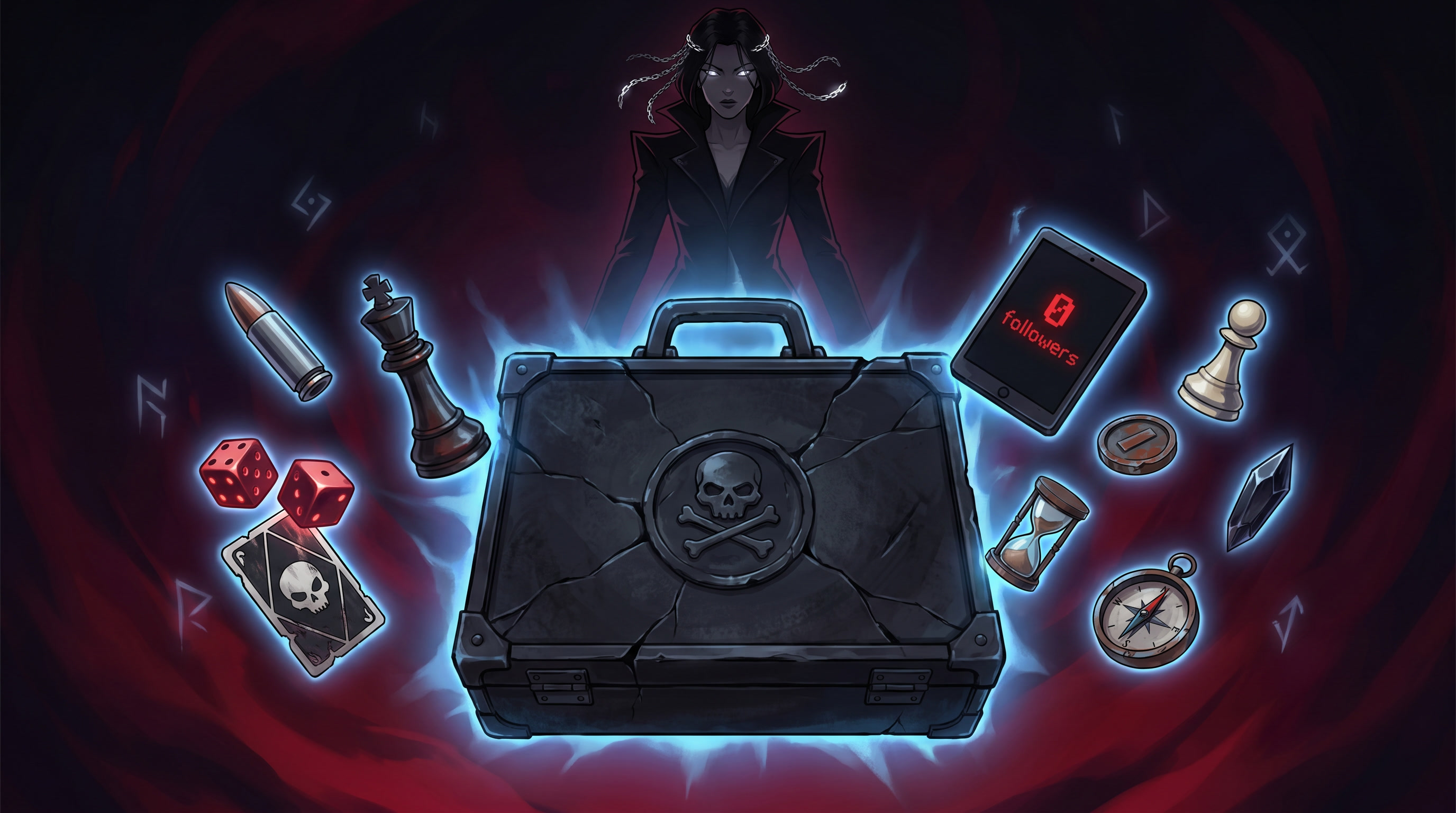
Death game anime is the genre Squid Game made famous in the West, but anime has been refining it for two decades. Eight rules. One bullet. A host who cheats. A protagonist who shouldn't have signed up. The genre's cleanest entries are listed below — including EXORCISTA: Games of Souls, the 2026 dark anime anthology by Victoria Unikel where each episode runs a different lethal game and a single silver-eyed collector named Exorcista takes the loser home.
This list is sorted by stakes weight — how real the consequences feel inside the rules of the show. We start with the entry that flipped the genre this year and work down through the classics.
What makes a true "death game anime" — the genre rules
A title earns the death-game tag when it satisfies four criteria:
- Codified rules. The death isn't random — it's a consequence of a specific game with a specific structure. Six chambers. One bullet. Eight pieces. One king.
- A host or system enforcing the rules. Sometimes a person, sometimes a building, sometimes a god. There is always an antagonist who runs the game.
- Permanence. Death sticks. No magic reset, no second chance, no resurrection.
- Choice inside constraint. The player can win — but only by understanding the rules better than the host who wrote them.
The 10 below all clear all four bars.
#1 EXORCISTA: Games of Souls
The 2026 entry that set the new bar. Each episode is a different fallen public figure dying in real life and waking in Content Hell, where a personal demon runs a different lethal game for their soul.
EP1 — Russian Roulette. Fake-coaching influencer Madison Cole sat across from Mammon and a single revolver. One round, one bullet, one truth she had to admit before she pulled the trigger. She ran out of lies first.
EP2 — Chess. Crypto CEO Jake Morrison plays Azazel on a holographic board where every captured piece is a victim's name. The cofounder. The mother. The retiree who lost thirty years of savings. The student with the loans.
Why it earns #1: the host always loses. Not "sometimes." Not "after a struggle." Every demon in this universe is built around a sin and a corresponding weakness — Mammon can't refuse a bet, Azazel can't admit he was wrong — and the show is engineered so the host's defeat is structural, not lucky. The win is never the survival. The win is collection.
→ Watch EP1 The Influencer (free, 4 minutes) · EP2 The Crypto Scammer — May 22 · The 1,000 Souls universe rule
#2 Kaiji: Ultimate Survivor
The genre's grandfather. An indebted gambler thrown onto a cargo ship for Restricted Rock-Paper-Scissors — three cards each, four stars, lose all your cards lose your kidneys. The math is the heart of the show. Kaiji works the problem on screen, in real time, and the audience works it with him. Followed by E-Card and the Steel Beam Crossing — both of them lethal, both of them brilliantly ruled.
#3 Liar Game
The cerebral end of the genre. A college student is invited to play a series of escalating money games where lying is encouraged and the only way to win is to find people who will tell you the truth. The math gets baroque. Every player has a different incentive structure. The only character who refuses to lie wins, because everyone else assumes she's lying.
#4 Future Diary (Mirai Nikki)
Twelve players. Twelve diaries that predict the future. The diaries betray each other constantly because no diary predicts what the other diaries will predict. Last one alive becomes god of time and space. The death game is not optional — refusing to play means your diary stops working, which means you die. The pacing is unhinged in the best way.
#5 Btooom!
Twenty-two players abandoned on a tropical island, each given one of eight types of explosives. Eight crystals to collect. Eight kills required. The protagonist is a top-ranked player of an online video game called Btooom! — which turns out to be the game he's now physically inside. The show works because the rules of the video game and the rules of the island start to diverge in interesting ways.
#6 Tomodachi Game
Five high school friends owe a collective debt. They're forced into games that test their friendship — quizzes, trust exercises, vote-out mechanics. Lose the game and the friend group personally pays a portion of the debt. The show is small in scope and devastating in execution. Friendship as the death game.
#7 Darwin's Game
A mobile game invitation. Click to install. The next time you open it, you're fighting a stranger to the death using a randomized superpower called a sigil. Online death game, offline consequences. The protagonist's sigil — copying any other player's ability — makes him the most valuable target in the game.
#8 King's Game
A small-town high school class starts getting late-night text messages signed The King. Each message is an order. Disobey within 24 hours and you die. The orders escalate quickly. The show works because it's the closest thing in the genre to a high-school horror movie — the death game is happening in their group chat.
#9 Doubt
Six players, one secretly designated wolf, the others rabbits. Find and execute the wolf to escape the locked building. The wolf, of course, will execute you first. Every player has a barcode tattooed on their body that scans red when killed. Closer in tone to a slasher movie than a strategic death game, but the rule-discovery sequences earn it the spot.
#10 Magical Girl Raising Project
The cuteness trap. A mobile app turns ordinary girls into magical girls. The catch: there are too many of them, and the app needs to cut the population in half. The girls are forced to murder each other to absorb each other's powers. The show is marketed as light shojo and functions as one of the heaviest entries in the genre.
Why "consequence" matters more than "violence"
The cheap version of the death game genre is just gore — a bunch of contestants shoved into an arena and slaughtered. The good version is rule-bound. Every death feels earned by the structure. Every survival feels paid for by intelligence or luck or sacrifice that the show makes you watch.
This is why Squid Game ranked so high on global streaming charts: it didn't just kill people. It killed people because of the rules of the game they had agreed to play. The audience didn't watch death. The audience watched consent become consequence.
EXORCISTA: Games of Souls inherits this directly. Madison Cole isn't murdered — she pulls the trigger herself. Jake Morrison isn't beaten at chess — he tips his own king. Both episodes end with the loser admitting they lost. That's the genre's hardest move and the show makes it twice in three weeks.
→ Read more on the genre's structure: What "1,000 Souls" Means
How EXORCISTA flips the genre: the host always loses
Most death-game anime keep the host invisible or untouchable. The host runs the game. The host wins by definition.
Games of Souls inverts this. The host is the antagonist. The host always cheats. The host always loses — not because Exorcista defeats them through superior play, but because the host's sin is structural. Mammon's sin is greed. Greed cannot stop. Azazel's sin is knowledge. Knowledge cannot admit it was wrong.
When Exorcista walks in at the end of every game, the host is already losing. She doesn't fight them. She collects them.
→ See all 10 demons + games map (Mammon, Azazel & the Demons of Games of Souls)
Where to watch
- EXORCISTA: Games of Souls — free on YouTube, @TheExorcista. Three Shorts per episode, ~4 minutes per episode, new episode every two weeks.
- Kaiji, Liar Game, Future Diary, Btooom!, Darwin's Game, King's Game, Magical Girl Raising Project — Crunchyroll (rotating availability).
- Tomodachi Game — Hulu / Crunchyroll.
- Doubt — manga only; the anime adaptation never finished.
For current streaming, check MyAnimeList seasonal listings and AniList genre filters.
Final pick if you only have one evening
Two episodes, one of each kind:
- EXORCISTA: Games of Souls EP1 The Influencer (4 minutes). The cleanest single-episode death-game in the genre right now. → Watch
- Kaiji episode 1 (~24 minutes). The classic. The one every other entry on this list is reacting to.
That's the lineage. From the cargo ship to Content Hell, the rules haven't changed — but the host always cheats, and now the host always loses.
→ EXORCISTA: Games of Souls show hub · Russian Roulette soundtrack · gamesofsouls.com