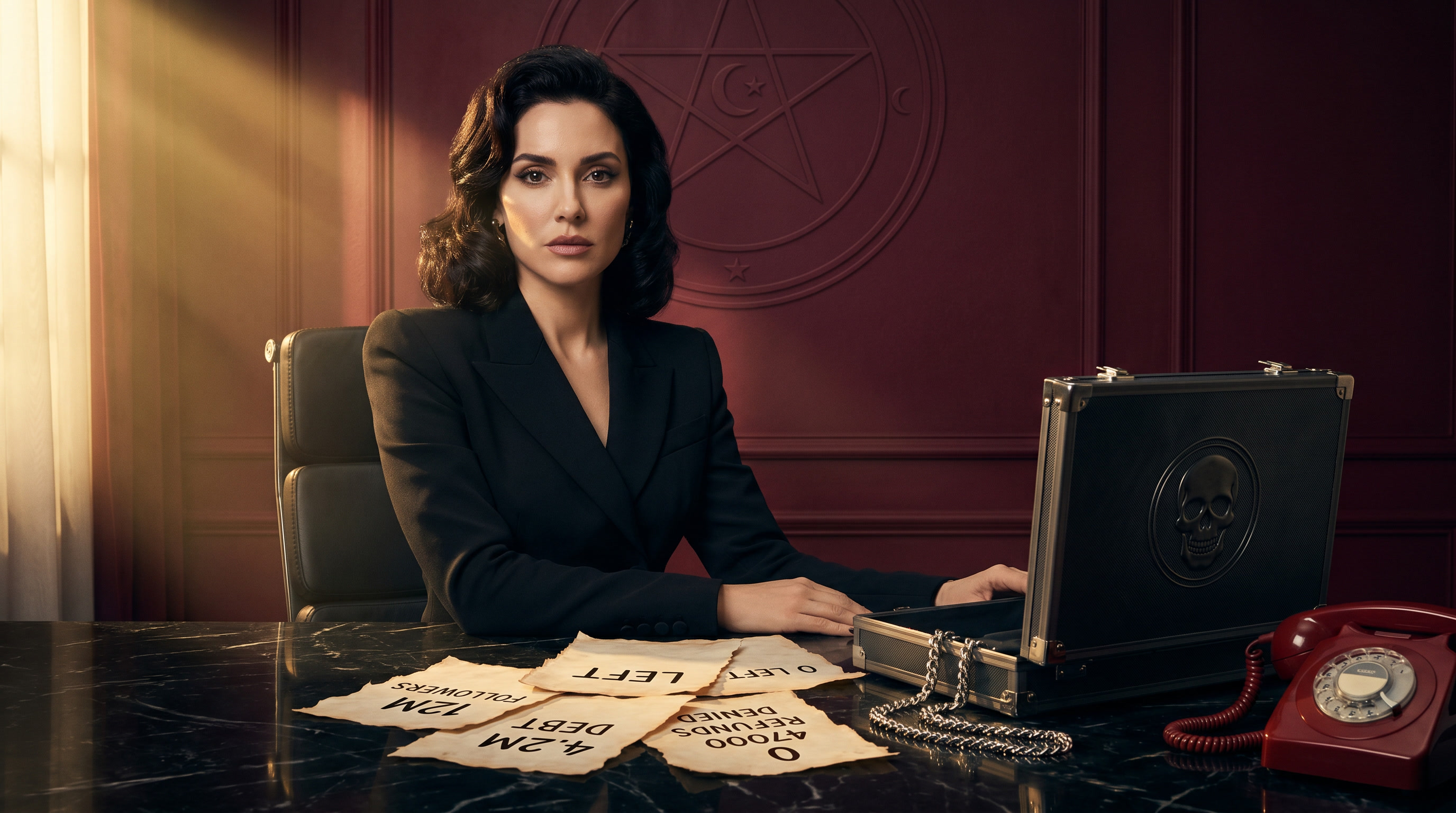
There's a kind of online predator who has been protected by the algorithm for too long. The fake-coaching influencer. The $997 "manifest your future self" course. The 12-million-follower DM funnel that ends with the buyer's credit card and the seller's lawyer. We made EXORCISTA: Games of Souls — a dark anime anthology — because we wanted that predator to face a host who can't be PR'd, can't be subscribed away, can't be muted. Mammon, the demon who runs the game show. And Exorcista, the silver-eyed collector who walks in when the game is over.
This is the story of why EP1 looks the way it does. The numbers are real numbers. The archetype is built from receipts. And the show is on YouTube right now, free, three Shorts per episode.
The receipt: $12,000,000 stolen, $4,200,000 in debt, 47,000 refund requests denied
Madison Cole, the central character of EP1, is not one person. She's an archetype assembled from public records, court filings, and the kind of internet receipts that get pinned to subreddit megathreads.
The number we settled on for her course price was $997. It wasn't picked at random. It's the price every serious researcher in the influencer-scam space recognizes — the just-under-thousand-dollar threshold that consumer-protection regulators flag as a tactic to avoid charge-back caps. The course is called Your Future Self. Twelve million followers bought in. The total revenue from the course alone, before the brand deals and the affiliate stack, is $12,000,000.
The debt: $4,200,000 owed to eleven different lenders. Court documents in the universe call them the eleven. Refund requests: 47,000, every one of them denied. Lawsuits filed against her: eleven. Followers remaining at the moment of her death: zero.
The show is fiction. The receipt is not.
Why the audience already knew her — the Madison Cole archetype
We tested the Madison Cole archetype with the audience six weeks before EP1 went live. We posted the soul card — name, brand, charge, status — to Instagram with no other context. The reply rate was the highest of any tease we'd run.
What people wrote back wasn't who is this character. It was I know exactly who you mean. Some of them named real influencers. Some of them named themselves — they had bought the course. One follower replied with a screenshot of her own credit card statement showing the charge.
That's the moment we knew the show would land. The audience wasn't waiting to be educated. The audience was the receipts.
Building Mammon as the demon who only loses when the truth shows up
The host of every Games of Souls episode is a different demon. EP1's is Mammon — the demon of greed, who in our universe runs the game show portion of Content Hell. He wears a $5,000 designer hoodie that splits open over the course of the episode to reveal ancient demon robes underneath. His eyes are golden dollar signs that spin faster the more he wants something. His voice is the voice of every charming tech-bro who ever gave you a free trial. He cheats with hidden card moves. His weakness is that he can't refuse a bet.
Mammon was designed to lose. Every demon in this universe is. The show's structural rule is: the host always cheats, the host always loses. Mammon's particular loss in EP1 happens at the moment Madison Cole admits — out loud, to a chamber full of dead followers and a single loaded revolver — that she knew the course was a scam. The truth lands. Mammon's voice glitches. Mammon goes on his knees. He yells THIS IS NOT FAIR. That frame is the meme of the season.
Then Exorcista walks in. She doesn't say anything for the first three seconds. She opens the briefcase.
The 1,000 souls rule and why this isn't a one-shot
The other thing the audience asked about was the counter. Every episode ends with the same on-screen text: SOULS COLLECTED: N / 1,000. After EP1, that line read 1 / 1,000. After EP2 it reads 2 / 1,000.
The rule is that Exorcista is one thousand souls short of completing her contract. She doesn't negotiate. She doesn't explain. She works through the list. Every episode is one fallen public figure — an influencer, a crypto founder, a missing-children mother, a beauty-industry predator — and one more soul collected.
The 1,000 souls rule is the reason the show is built as an anthology and not a serial. We didn't want a season-long arc with one antagonist. We wanted a series-long arc with one collector. That structural choice is what makes the show work. Every episode is its own complete object. Every episode is also one row in the same ledger.
→ Read the full 1,000 Souls universe rule
Why YouTube Shorts, why phonk, why now
Three Shorts per episode is a deliberate choice. The format constrains us in good ways. Each part has to land its hook in the first eight seconds. Each part has to leave a clean cut into the next part. The episode is short enough that anyone can finish it in a coffee break and long enough that it doesn't feel disposable.
The score is industrial metal, drift phonk, and symphonic horror. We made it that way because the audience for this show is the audience that already listens to KORDHELL, Trent Reznor, Mick Gordon, Rammstein, Sara Landry. The album, Russian Roulette, is on every DSP. Every track is a scene. Track 1 is the leitmotif of the collector. Track 2, Ding Ding, is the bell that opens the game. Track 5, Hellfire Chains, is what the chains sound like when she opens the briefcase.
→ Listen on Spotify · Apple Music · YouTube Music
The "why now" is the simplest answer of the three. Squid Game showed the world the audience was ready for a death-game story aimed at adults who recognize the rules. Anime had been refining this genre for two decades. The tools to produce a stylized dark-anime anthology on a YouTube Shorts cadence are finally available to an independent producer. So we did it.
What EP2 is — and why the next archetype is a $200M crypto CEO
EP2 launches May 22 with a different demon, a different game, and a different archetype. The victim is Jake Morrison, a crypto CEO whose chain unwound and whose 12,000 investors are still trying to recover what's left. The number that landed for that archetype was $200,000,000. The detail that set the tone was that his own mother — Linda Morrison — mortgaged her house because her son had told her the chain was safe.
The host this time is Azazel. White designer suit dissolving into ancient orange robes. Silver-white chrome eyes. An orange Bitcoin tattoo on the left side of his neck. British accent. The game is chess. Each captured piece is a victim's name.
Azazel does not panic when he loses. He dissolves standing up. The contrast with Mammon's collapse on his knees in EP1 is intentional — the universe has rules about how each demon dies, and the rules are determined by the sin.
EP2's companion album, Checkmate, drops May 15 on every DSP. It's a separate album from Russian Roulette. The pattern from here forward is: album one week before the episode, episode every two weeks.
How to watch all 3 parts in 4 minutes
Three YouTube Shorts. ~4 minutes total. No subscription wall. No region lock.
→ Watch EP1 The Influencer (start here) → EP2 The Crypto Scammer (countdown to May 22) → Full series playlist on YouTube
Press, interviews, partnerships
We're booking interviews on the show, the universe, the production approach, the music. The press kit (downloads, photos, episode synopses, music samples) is at theexorcista.com/press. For interview booking and partnership inquiries, email [email protected], handled by VUGA Media Group.
→ Press kit · Creator profile — Victoria Unikel · Wikidata entity · IMDb
The show is on YouTube. The receipts are real. The host always loses. Soul one of one thousand has been collected. Nine hundred and ninety-nine to go.